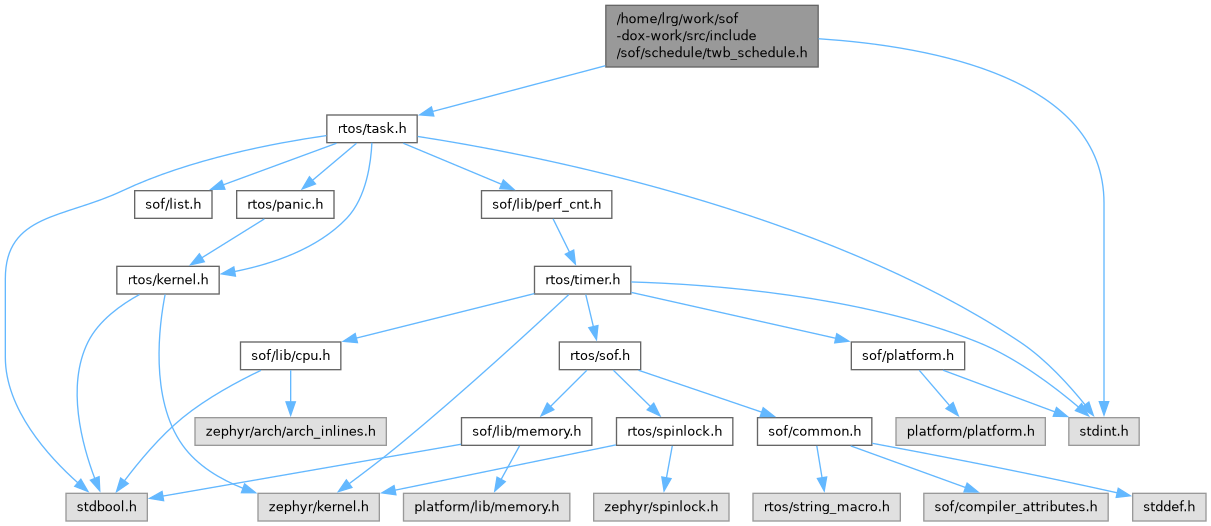
Go to the source code of this file.
Macros | |
| #define | ZEPHYR_TWB_STACK_SIZE 8192 |
| Task With Budget (TWB) Scheduler. | |
| #define | ZEPHYR_TWB_BUDGET_MAX (CONFIG_SYS_CLOCK_TICKS_PER_SEC / 1000) |
| max budget limit | |
| #define | SYS_TICKS_TO_HW_CYCLES(x) |
| #define | HW_CYCLES_TO_SYS_TICKS(x) |
Functions | |
| int | scheduler_twb_init (void) |
| Init the Tasks with Budget scheduler. | |
| int | scheduler_twb_task_init (struct task **task, const struct sof_uuid_entry *uid, const struct task_ops *ops, void *data, int32_t core, const char *name, size_t stack_size, int32_t thread_priority, uint32_t cycles_granted) |
| initialize a TWB task and add it to scheduling It must be called on core the task is declared to run on | |
Macro Definition Documentation
◆ HW_CYCLES_TO_SYS_TICKS
| #define HW_CYCLES_TO_SYS_TICKS | ( | x | ) |
◆ SYS_TICKS_TO_HW_CYCLES
| #define SYS_TICKS_TO_HW_CYCLES | ( | x | ) |
◆ ZEPHYR_TWB_BUDGET_MAX
| #define ZEPHYR_TWB_BUDGET_MAX (CONFIG_SYS_CLOCK_TICKS_PER_SEC / 1000) |
max budget limit
◆ ZEPHYR_TWB_STACK_SIZE
| #define ZEPHYR_TWB_STACK_SIZE 8192 |
Task With Budget (TWB) Scheduler.
TWB scheduler is a scheduler that creates a separate preemptible Zephyr thread for each SOF task that has a pre-allocated MCPS budget renewed with every system tick. The TWB scheduler assigns either MEDIUM_PRIORITY or LOW_PRIORITY to the task thread based on the budget left in the current system tick. It allows for opportunistic execution if there is no other ready task with a higher priority while the budget is already spent.
Examples of tasks with budget include IPC Task and IDC Task.
The TWB scheduler has two key parameters assigned:
- cycles granted: the budget per system tick
- cycles consumed: the number of cycles consumed in a given system tick for task execution
The number of cycles consumed is reset to 0 at the beginning of each system tick, renewing the TWB budget. When the number of cycles consumed exceeds the cycles granted, the task is switchedfrom MEDIUM to LOW priority. When the task with budget thread is created, the MPP Scheduling is responsible for setting the thread time slice equal to the task budget, along with setting a callback on time slice timeout. Thread time slicing guarantees that the Zephyr scheduler will interrupt execution when the budget is spent, so the MPP Scheduling timeout callback can re-evaluate the task priority.
If there is a budget left in some system tick (i.e., the task spent less time or started executing closeto the system tick that preempts execution), it is reset and not carried over to the next tick.
default static stack size for each TWB thread
Function Documentation
◆ scheduler_twb_init()
| int scheduler_twb_init | ( | void | ) |
Init the Tasks with Budget scheduler.
◆ scheduler_twb_task_init()
| int scheduler_twb_task_init | ( | struct task ** | task, |
| const struct sof_uuid_entry * | uid, | ||
| const struct task_ops * | ops, | ||
| void * | data, | ||
| int32_t | core, | ||
| const char * | name, | ||
| size_t | stack_size, | ||
| int32_t | thread_priority, | ||
| uint32_t | cycles_granted ) |
initialize a TWB task and add it to scheduling It must be called on core the task is declared to run on
- Parameters
-
[out] task pointer, pointer to allocated task structure will be return [in] uid pointer to UUID of the task [in] ops pointer to task functions [in] data pointer to the task data [in] core CPU the thread should run on [in] name zephyr thread name [in] stack_size size of stack for a zephyr thread [in] thread_priority priority of the zephyr thread [in] cycles_granted cycles budget for the zephyr thread